Sportsbook Arbitrage: Seizing Guaranteed Profits from Odds Disparities
Sportsbook Arbitrage: Seizing Guaranteed Profits from Odds Disparities

Understanding the Basics of Arbitrage Betting
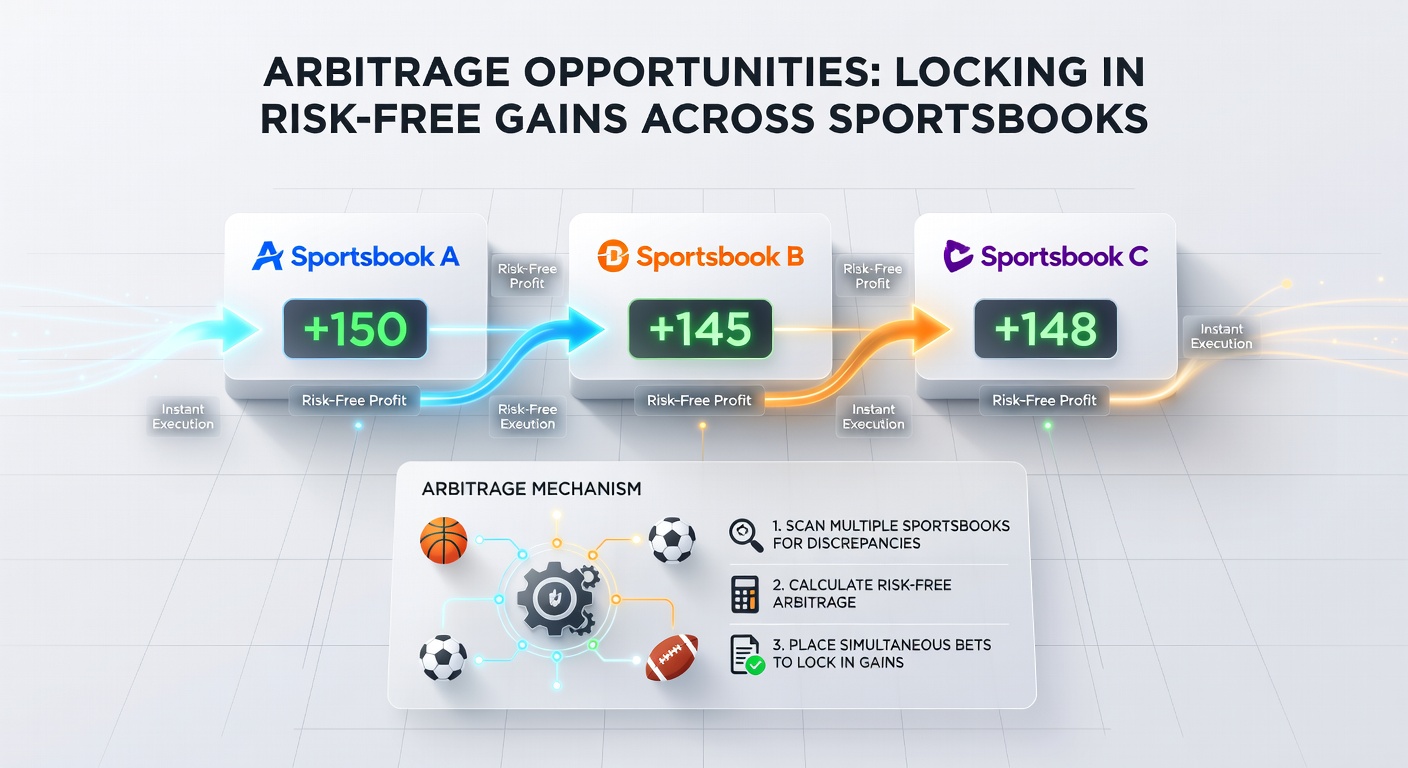
Sportsbook arbitrage, often called "arbing," emerges when odds differences across multiple betting platforms create opportunities for bettors to wager on all possible outcomes of an event, thereby locking in a profit regardless of the result; experts note that this strategy exploits the competitive nature of the sports betting industry, where books set lines independently to attract action. Data from industry trackers shows that such discrepancies arise frequently, especially during high-volume periods like major league seasons, because sportsbooks adjust odds based on their own customer betting patterns, liquidity, and risk models.
Take a straightforward soccer match between Team A and Team B; if one sportsbook offers +110 on Team A (implying a 47.6% implied probability) while another lists Team B at +120 (45.5% probability), and a third provides a draw at even money, the combined implied probabilities fall below 100%, creating an arb window of say 2-5%. Bettors calculate stakes proportionally using formulas like the arbitrage percentage—(1 / odds1 + 1 / odds2 < 1)—to ensure balanced exposure; those who've mastered this spot opportunities yielding 1-3% per bet, which compounds over volume.
What's interesting is how arbing predates online betting; observers trace its roots to physical bookmakers in Las Vegas during the 1990s, but digital platforms amplified it exponentially since mobile apps and APIs made real-time odds comparison seamless.
How Odds Disparities Fuel These Opportunities
Books compete fiercely for market share, so they shade lines differently based on regional preferences—U.S. operators might favor moneylines while European ones emphasize spreads—leading to natural vig variations; research from the American Gaming Association indicates that in regulated markets, average vig hovers around 4-6%, but cross-book differences push arb chances higher during volatile events. And as live betting grows, in-play odds shift rapidly, opening micro-arbs lasting seconds.
Figures reveal that MLB games in early season often produce the most arbs because of pitcher prop variances; for instance, one book might post over/under 5.5 strikeouts at -110 either way, while another tilts to -130 on the over due to weather models, creating a hedgeable gap. Bettors scale this by deploying across dozens of games daily, turning small edges into substantial returns.
Step-by-Step: Executing an Arb Bet
Spotting an arb starts with odds aggregators that scan 50+ books in real time; once identified, bettors compute stakes—say $1000 total bankroll split as $526 on Team A at +110 and $474 on Team B at +120—yielding $52.60 profit no matter who wins, a clean 5.26% return. Tools automate this, alerting users via apps when arb percentages exceed thresholds like 1% after juice.
But here's the thing: timing matters, since lines move fast; successful arbers maintain accounts at 10-20 books, funding them via e-wallets for speed, and they round bets to avoid patterns that flag accounts. One case study from sharp bettors shows a syndicate clearing $50,000 monthly by arbing NBA totals during April 2026 playoffs, as Eastern Conference semis drew lopsided action on favorites.
Now, in April 2026 specifically, as NBA and NHL playoffs ramp up alongside MLB's early grind, data from U.S. markets highlights a surge; Nevada Gaming Control Board reports show handle spiking 15% year-over-year, with odds flux from injury news creating prime arb windows on player props like LeBron James points over/under.
Tools and Platforms Powering Modern Arbing
Software like OddsJam or RebelBetting scans feeds from global books, filtering arbs by sport, stake size, and ROI; free versions flag basics, while premiums offer closing line value trackers to verify edges. API integrations pull live data, calculating liabilities instantly so bettors act before opportunities vanish—often in under 30 seconds.
Experts who've studied this landscape observe that VPNs help access geo-restricted books, like Ontario's via Alcohol and Gaming Commission of Ontario markets, where CAD lines differ from USD ones; meanwhile, crypto books add anonymity, though traditional wires remain king for volume players. Turns out, spreadsheet wizards build custom models too, cross-referencing historical arb frequencies per matchup type.
Case in point: during the 2026 Masters golf tournament prep in April, prop arbs on top finishers popped at 2.5% averages across offshore and regulated sites, as books balanced amateur-heavy parlays differently.
Challenges and Realities Bettors Face
While arbs promise risk-free gains, sportsbooks counter aggressively; accounts get limited to $10 max bets after patterns emerge, or worse, shut down entirely—data indicates 70% of high-volume arbers hit caps within months. Voids from lineup changes eat profits too, since not all books honor symmetric rules, and rounding errors compound on low-odds parlays.
Yet those who diversify across 50+ books, mixing arbs with square bets, extend lifespans; observers note that U.S. states like New Jersey enforce consumer protections, minimizing outright bans, although terms of service deem arbing "abuse." International reports from Australia's state regulators highlight similar dynamics, with self-exclusion tools ironically aiding pros to manage heat.
Regulatory filings in April 2026 underscore this tension; Pennsylvania's gaming board documented $1.2 billion in sports wagers, up 20%, fueling more arb hunts amid operator consolidations like FanDuel's expansions.
Legal Landscape and Market Evolution
Arbitrage itself holds legal status everywhere sports betting operates, as it involves no fraud—just exploiting public odds; however, books' private policies govern account treatment, leading to shadowbans rather than prosecutions. Industry analyses from European bodies like the Malta Gaming Authority affirm this, stressing fair play while allowing promotional terms to deter pros.
So as legalization spreads—Canada's full rollout, Brazil's pilots—arb pools deepen, with cross-border plays via licensed offshore options; but compliance remains key, with KYC tying funds to identities. Bettors track state-by-state rules, like Colorado's low-hold mandates that inadvertently boost arb viability by squeezing vig.
It's noteworthy that April 2026 data from multiple jurisdictions paints a booming picture: total U.S. sports handle topped $12 billion monthly, per AGA tallies, with arbs thriving on futures markets for Stanley Cup odds.
Wrapping Up: Arbitrage in Today's Betting World
Arbitrage stands as a mathematical edge in an otherwise chance-driven space, rewarding discipline and tech savvy with consistent, low-risk returns; while books evolve defenses, the sheer volume of events ensures opportunities persist for those who scout diligently. Data consistently shows pros averaging 5-10% ROI yearly after costs, scaling via syndicates or bots—though newcomers start small to test waters.
As April 2026 unfolds with playoff fervor and regulatory tweaks, the arb game sharpens; bettors who blend it into broader strategies not only lock profits but navigate the ecosystem sustainably, turning odds quirks into reliable income streams amid industry growth.